






How HMG Sizing Works
Most Hyperlite packs use a unified sizing system based on torso length—not overall height. Because our technical backpack designs rely on a clean, streamlined suspension without load lifters or bulky adjustment systems, choosing the correct torso size is the key to achieving the balanced, close-to-body carry our packs are known for. Once you know your torso measurement, that size applies consistently across all of our 40L, 55L, and 70L backpack models.
Running-vest packs like the Pemi 15 and Aero 28 size by chest circumference rather than torso length — switch tabs in the tool below to use their dedicated fit guides.

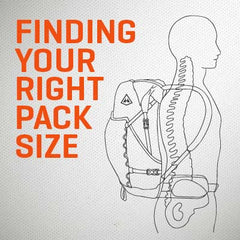
Torso length runs from your C7 vertebra down to your iliac crest. The tool below walks you through it.
Find Your Pack Size
Our packs size differently depending on the style. Select your pack type below to get the right measurement instructions and your exact size.
What are you sizing for?Find your C7 vertebra
Tilt your chin to your chest. The most prominent bony bump at the base of your neck where it meets your shoulders is your C7 vertebra — the top of your measurement. Have a friend mark this spot.
Find your iliac crest
Stand upright. Place both hands on your hips, thumbs pointing behind you, and slide down until they rest on the top shelf of your hip bones. Point thumbs toward your spine — the imaginary line between your thumbs is the bottom of your measurement.
Measure along your spine
Have a friend run a flexible tape from your C7 down along the curve of your spine to the iliac crest line. That distance is your torso length.
Your pack size
—
Available in this size
Verify your fit
Once your pack arrives, load it with typical gear and weight. Check that your shoulder straps fit correctly using these guides:

Too Small

Just Right

Too Large
Not sure? Easy exchanges within 30 days on new, unused gear. Order your best size, test it loaded at home, and swap if needed — no hassle.
Measure your torso length
Tilt chin to chest, locate C7 (prominent bump at base of neck). Stand upright, place hands on hip shelf (iliac crest) with thumbs pointing back. Have a friend measure from C7 down your spine to the line between your thumbs.
Measure your chest circumference
Wrap a flexible tape measure around the fullest part of your chest, level under your armpits and across your shoulder blades. Breathe normally — don't expand or compress your chest. Measure while wearing the base layer you'll typically use.
Your Aero 28 size
—
Verify your fit
Once your pack arrives, load it with typical gear and weight. Check that your shoulder straps fit correctly using these guides:
Too Small
Just Right
Too Large
Not sure? Easy exchanges within 30 days on new, unused gear. Order your best size, test it loaded at home, and swap if needed — no hassle.
Measure your chest circumference
Wrap a flexible tape measure around the fullest part of your chest — level under your armpits and across your shoulder blades. Breathe normally. Measure while wearing the layers you'll actually run in.
Consider your build
The Pemi 15 has minimal stretch, so fit matters more than on a standard pack. A snug fit is essential to limit bounce while running.
Your Pemi 15 size
—
The Pemi 15 has no traditional hip belt — fit is all about how the vest wraps your chest and torso. Run through this before your first outing.
- Vest lies flat and snug across your chest — no gaps or slack at the sides
- Front shock cord is adjusted so flask pockets sit close to your body without bouncing
- The welded foam back panel contours flush against your back — no lifting or tilting
- When loaded and running, the pack does not shift or bounce — if it does, try tightening the sternum system before sizing up
Verify your fit
Once your pack arrives, load it with typical gear and weight. Check that your shoulder straps fit correctly using these guides:
Too Small
Just Right
Too Large
Not sure? Easy exchanges within 30 days on new, unused gear. Order your best size, test it at home, and swap if needed — no hassle.
